ARIA.
360° factory management.
ARIA runs the factory: it puts the line, the PLCs, the warehouse, the mobile robots and the people on the floor on the same data, on the phone too. MES/SCADA and traceability, warehouse management (WMS), AMR fleet and HMI: each module works on its own, together the factory runs from one place. Modular, configurable and already in production.
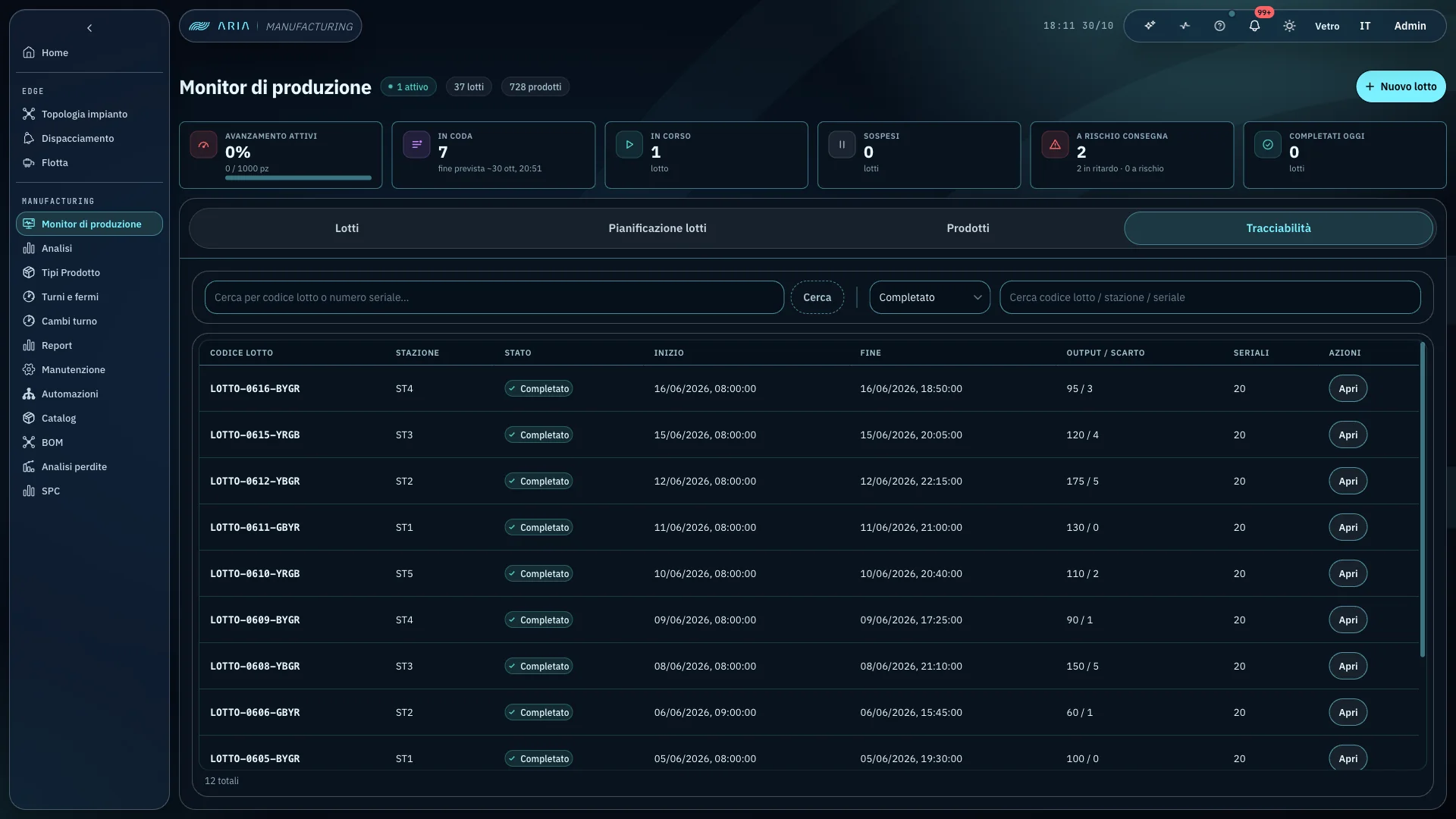
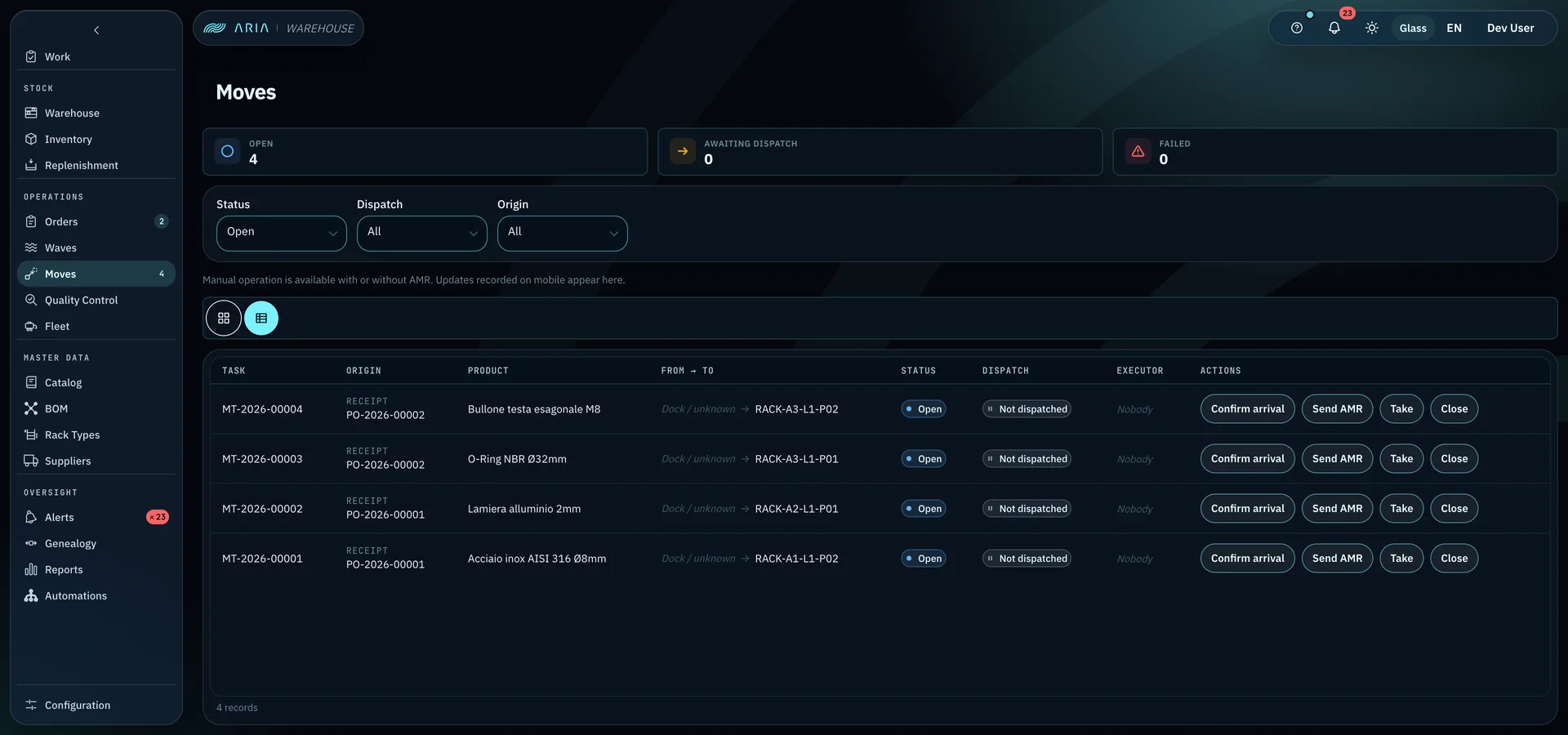
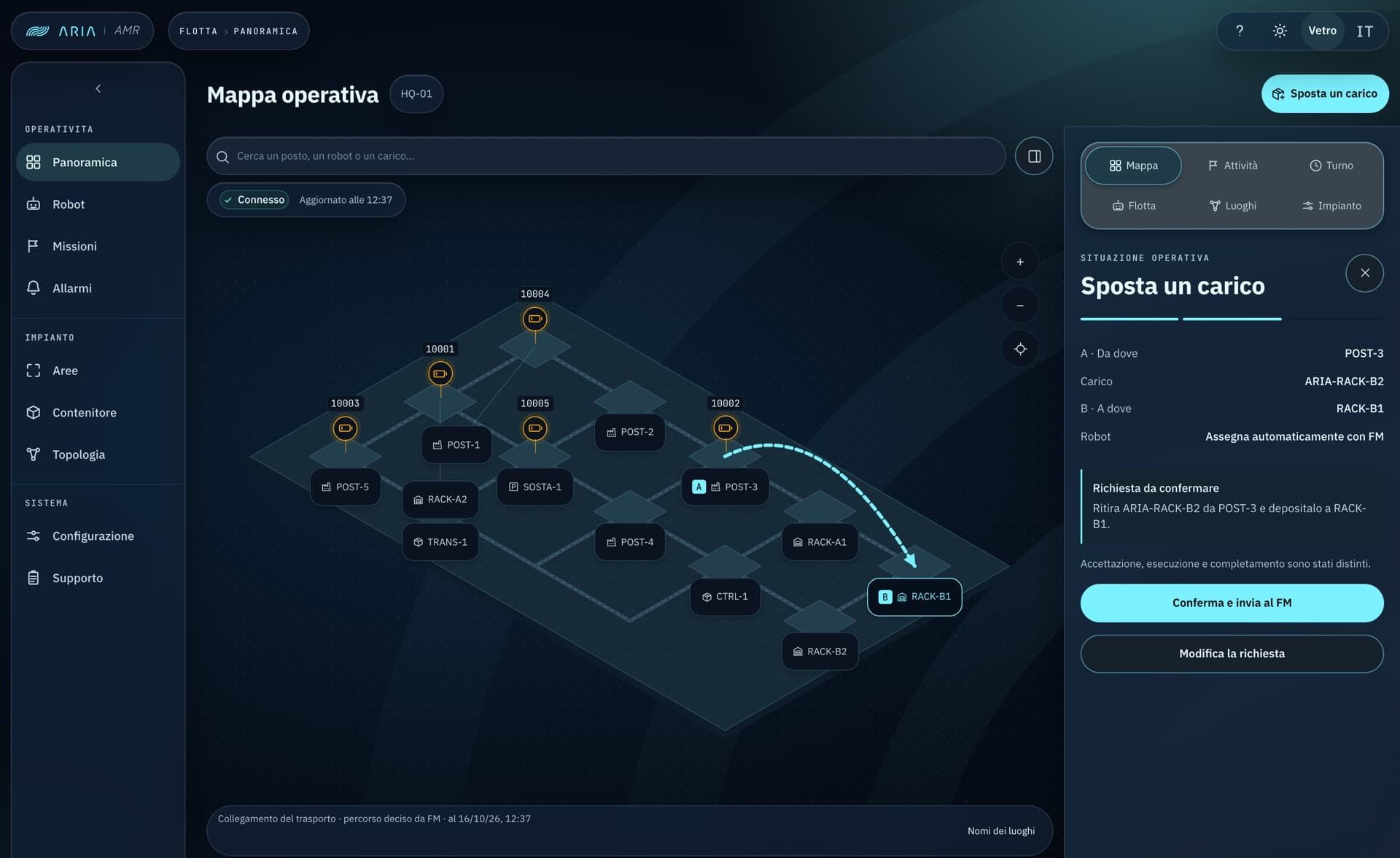
- Modules5Track, MES/SCADA, Warehouse, AMR, HMI: each on its own, or all together
- Data1One item master between line and warehouse, one user system
- Alarms1 listLine, warehouse and fleet in the same list
- FieldOPC UA · S7Connects to the PLCs already on the line and runs them, without replacing them
ARIA is built by IOMA, an industrial IT/OT partner: PLC programming, robotics, line integration, and plant consulting for the systems the software then governs.
Every department has its own tool. Everyone looks at the same data.
From the PLC to the workstation, from the warehouse to the robot: ARIA's modules share item masters, users, alarms and flows. What happens in one department is known at once to whoever needs it.
ARIA Track
Line · read-onlyProduction traceability software: know where every part came from.
Entry edition of MES/SCADAOpen ARIA TrackARIA MES/SCADA
Line · control roomMES and SCADA software: see and run the whole line from a single cockpit.
Lite and Pro editionsOpen ARIA MES/SCADAARIA Warehouse
Warehouse · AMR fleetWMS software for warehouse management and internal logistics, on its own or with the line.
Works without MES/SCADA tooOpen ARIA WarehouseARIA AMR
Shop floor · AMR fleetAMR console for intralogistics: from the warehouse to the line and back.
Connects to the manufacturer's fleet managerOpen ARIA AMRARIA HMI
Station · remote tooIndustrial HMI: custom panels, or panels generated from the PLC across stations, remote too.
The framework for operator panelsOpen ARIA HMI
The shared layer
Under every module there is the same layer: what one module records or decides, the others know.
- Item master and bill of materialsDefined once: the line knows what it makes, the warehouse knows what it needs.
- Users and rolesOne access system for every module.
- AlarmsLine, warehouse and fleet in the same list.
- Flows and automationsThe path of the product between stations and the «if X happens, do Y» rules apply to every module.
Field · PLCs, fleets, machines. ARIA runs the factory: through the connector it links to PLCs (OPC UA and S7) and to the AMR fleet, and where needed it extends with custom development. It decides the next step of the flow, loads recipes onto the machine and, with automations armed by a person, can write to the PLC.
ERP and business software. ARIA exposes data read-only over API and webhooks. There is no ready-made ERP connector: the integration is set up together.
Beyond the modules: built on the suite, for your plant.
If you need something that is not in the catalogue, we develop it on the same platform: where the connector does not reach out of the box, we extend it.
- Operations centres, remote too
- Dedicated HMI panels, for example for signal checking
- Custom integrations
Where the modules really talk to each other.
These are not promised features: they are data hand-offs that exist between one module and another, and between the suite and the machine. Those still being built are marked.
- PLCMES/SCADAAvailable
ARIA decides the production flow.
When a machine asks to work a part, ARIA answers with the next process according to that product's flow. Recipes are saved from the PLC and loaded onto the PLC, with versions side by side. The flow can be switched off, and ARIA used for traceability alone.
- MES/SCADAWarehouseAvailable
One item master, one bill of materials.
The line's product type and the warehouse's item are the same item: what is made and what the warehouse needs start from a single piece of data.
- MES/SCADAWarehouseAvailable
At the end of a batch the warehouse updates itself.
When a batch closes, the components of the bill of materials leave the warehouse — by lot, first expired first out — and the finished product comes in. Needs ARIA Warehouse switched on.
- MES/SCADAAMRAvailable
Transport is a step of the production flow.
A flow step can hand the transport to a robot: the part moves on when the mission closes. If the mission fails, a person sees it and decides.
- WarehouseAMRAvailable
A warehouse move becomes a mission.
A move decided in the warehouse starts as a fleet mission; when the mission is done, the stock follows.
- All modulesAvailable
An event opens an action, in any module.
A line stoppage, stock below threshold, a PLC signal: they raise an alarm, notify a person, prepare a draft reorder, send a robot or write a value to the PLC. Automations are born disarmed: they run as a dry run until a person arms them. Pro plan.
- MES/SCADAAMRComing
The robot feeds the line start and clears the line end.
At the start of a batch, every N finished parts or on a confirmed request, an AMR brings material to the line start or picks up the full container at the line end. Needs the Pro plan.
- AURAAvailable
One question, three modules.
AURA answers on stations, warehouse and fleet, from the data the platform has already recorded. In Warehouse it can also prepare a proposal — a rack, a move, a transport with AMR — that the person confirms: nothing starts on its own. It is an add-on module.
A lot goes through the factory.
Followed from receiving until someone asks where it is: six steps, four modules, no sheets to cross-check.
- Warehouse
Raw material comes in
Receiving with quality control and quarantine; every lot carries its expiry date.
- AMR
The robot takes it to the line
The transport starts from a click, a warehouse move or a line event.
Coming · starts with the batch - MES/SCADA · Track
The line produces and records
Batch, station status, alarms and traceability of every part; the HMI works at the machine.
- Warehouse
The warehouse updates
At the end of the batch, components leave by lot and the finished product comes in.
- AMR
The full container leaves the line end
A robot picks up the container every N finished parts and takes it to the drop-off.
Coming - AURA
Someone asks where it is
A plain-words question about a lot, a shift or a station.
ARIA Track
Pricing and calculatorlist price€9501st station / year
Per station, tiered: traceability only.
ARIA MES/SCADA
Pricing and calculatorlist price€1,2001st station / year
Per station, tiered.
Two editions: Lite €1,200 and Pro €1,650 for the first station, per year. Pro adds OEE and MTBF, the batch scheduler and energy analysis.
ARIA Warehouse
Pricing and calculatorlist price€6,500per warehouse / year
Per warehouse, not per user or per location.
AURA
What it is, what it costsThe AI assistant is an add-on module: priced separately.
€250 per station on MES/SCADA, €750 per warehouse on Warehouse, €250 per robot on AMR, per year. On MES/SCADA it adds to Lite and Pro, not to Track.
HMI and tailored projects are quoted per project, not from the price list. The mobile app is included with compatible modules.
Request a quotePrices exclude VAT · perpetual licence. The list price is the annual fee per unit: paying the whole licence upfront costs 10% less. One-off turnkey commissioning is billed separately, travel excluded. Tiers, editions, and the calculator on each module's page.
Eligible for Italy's 2026 iperammortamento.
ARIA qualifies as eligible software: requirements are checked on your project with your advisor, and our guide explains how to apply.
How the data arrives
Interval polling and manual refresh: what you see is a few seconds old.Push events: the field changes, the dashboard changes.
The shift lead sees the stoppage as it happens, not at the end of the shift. That is the difference between acting and recording.
How many platforms
MES/SCADA, WMS, and HMI from different vendors, wired together per project — and wired again on the next one.Modules of one platform, interoperable with each other: they exchange data with no integration to build.
One set of master data, one user model, one PLC integration. Adding a module is a configuration, not an integration project.
Who does the implementation
Custom development, with a workload that lands on your IT department and your technicians.Plug and play: we install, configure, and connect. Nothing is left for you to implement.
The default is configuration, not code: toggleable modules and hierarchical roles. If your process needs something that isn't there we build it — but that stays a choice, not the premise of the project.
How long it takes
Months of site work before the first useful data point.Weeks: installation, PLC connection, and go-live.
A line with monitoring and traceability goes live in weeks. Months only come in when recipes, flow orchestration, and ERP integration join the scope — and in that case we put it in the quote.
Where it is used
A desktop station in the control room, plus a proprietary panel to license for every workstation.A browser on any panel, plus the app in your pocket for whoever walks the floor.
No per-panel licence and no dedicated station: whoever needs to look, looks from where they are.
What it can answer.
Station status and OEE, alarms by severity, station, and date, production and current shift, station comparison. Then batches and genealogy, recipes, product types and flows, the path a part took along the line. It also searches the station manuals: it cites the manual, and does not improvise a procedure.
It does not act on its own, no access to the PLC.
AURA only queries data the platform has already recorded: it sends no commands to the field and does not touch the PLC. In Warehouse it can prepare a proposal — a rack, a move, a transport with AMR, an automation draft — that the app runs only after you confirm, with your permissions.
It runs inside the plant.
AURA answers from the plant server, alongside the rest of the platform. Production data does not leave the company network, unless you choose to connect an external service.
Conversations are not kept.
There is no archive of questions and answers: the conversation lives in the session of whoever is asking, and ends there. No history to retain, to export, or to secure.
Where it's available.
AURA is an add-on module of ARIA MES/SCADA, outside the plans: it adds to Lite or Pro, on every station, at a per-station price shown in the price list. The Track edition does not offer it. It can be integrated across the suite — available today in ARIA MES/SCADA, ARIA Warehouse and ARIA AMR.
Referrer
You pass us the contact and we close it. No commitment and no demo to prepare: commission comes on the sale and on every renewal.
Reseller
You run the deal, with us in presales on the technical demos. Higher commission, and for established partners we consider reselling under your own name.
The questions people really ask when they choose.
What buyers of production software ask before a first call: what it is, what it costs, what it connects to.
What is ARIA?
What is a MES, and how does it differ from SCADA, WMS and ERP?
Is ARIA a DCS?
How much does ARIA cost?
Does ARIA connect to my ERP?
Do you build custom work on top of ARIA?
Is ARIA eligible for the iperammortamento?
Which PLCs does ARIA read?
What is ARIA HMI?
Guides that go deeper on these topics.
- Guide9 min
MES vs SCADA: what each one really is, and how to decide without being sold smoke.
Read the guide - Guide10 min
How much does MES or SCADA software cost? Real numbers, not “it depends”.
Read the guide - Guide9 min
How much does warehouse management software cost? Real numbers, not “it depends”.
Read the guide - Incentives12 min
Transizione 5.0 and Italy's 2026 hyper-depreciation: the incentive guide, without losing months.
Read the guide
Let's see what you actually need.
Half an hour with the team that builds the platform: which modules you need, how they connect to the PLCs you already run, and what it costs on your stations. No commitment.
Or:see the modules and pricinghey@ioma.ai