What AURA can answer, and how you ask.
AURA is the AI assistant in the Pro plan of ARIA MES/SCADA. Ask in your own language what you would ask a shift lead: station status, yields, alarms, batches, recipes. It reads the data the platform already records, and when there is none it says so.
Line status, right now
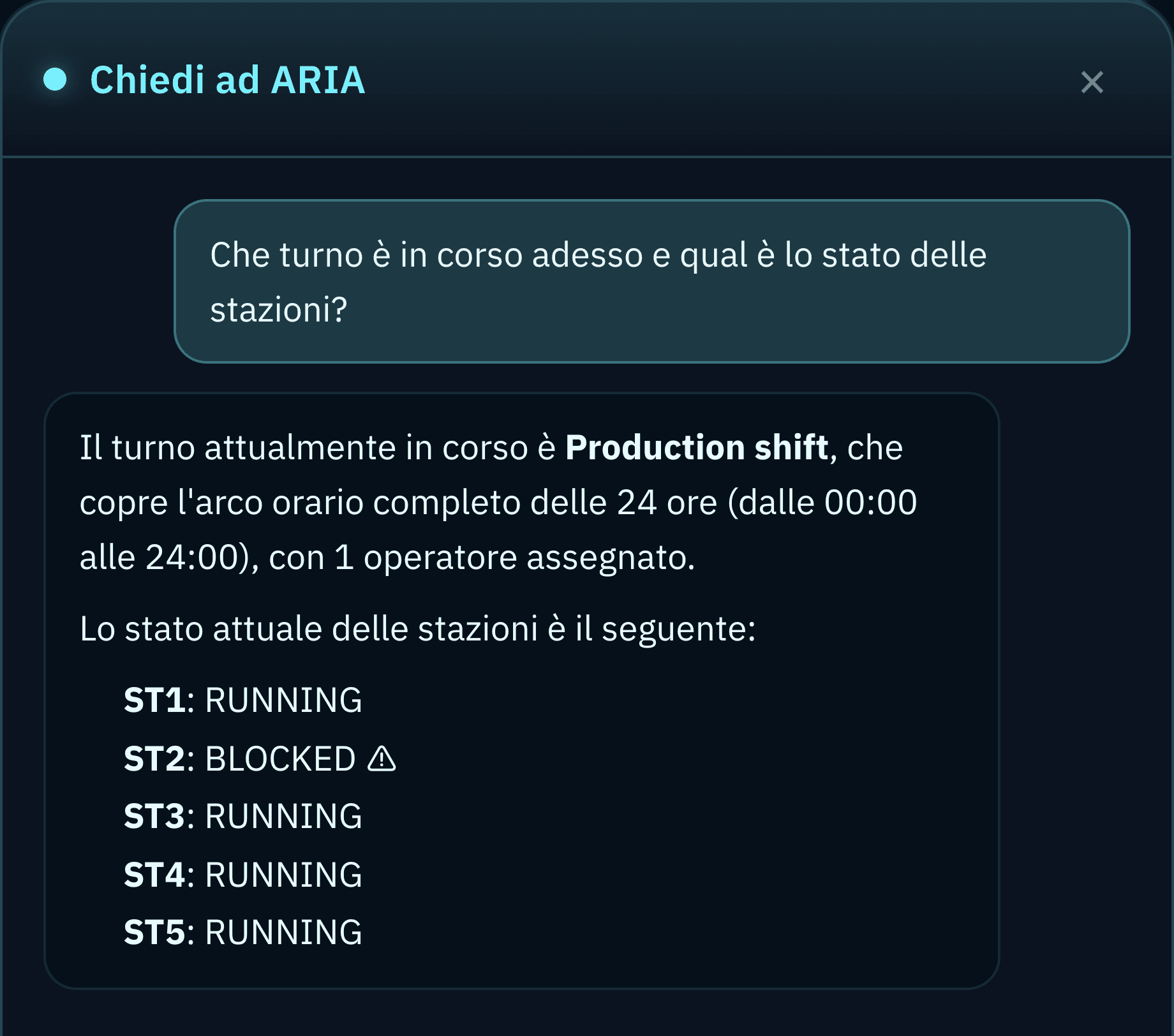
Which stations there are, what state they are in — running, in alarm, waiting, blocked or under maintenance — and for how long. Which shift is running and how many people are assigned. What a single station does, with what cycle time and where it sits on the line.
- “Which stations are in alarm, and for how long?”
- “Which shift is running right now?”
Yields and output
OEE, availability and quality over a date range, for the whole line or for one station. Pieces produced day by day, good ones and scrap. A station-by-station comparison on pieces, quality and cycle times.
- “What was the line's OEE in June?”
- “Which station has the worst cycle times?”
Alarms
Alarms filtered by state — open, acknowledged, resolved — by severity, by station and by date range. The count comes back with the list, so “how many” gets an answer instead of a list to count.
- “Are there any open alarms?”
- “Which severe alarms did ST2 have last week?”
Batch traceability
The record of a batch from its code: status, counts, process parameters, input materials. Genealogy says which batches and materials it was built from. And for a single part there is the step-by-step path, with process, station, result and cycle time.
- “What materials was batch B-1042 built from?”
- “What path did the part with code X take?”
How production is structured
Product types and the flow each one runs, with the ordered sequence of processes and the rework branches. The active recipe of a product type, with per-station parameters and, where it exists, the list of work instructions.
- “What path does this product follow, and where does it go if it fails?”
- “What recipe parameters does product A-12 have at the pressing station?”
The station manuals
Procedures, error codes, settings and instructions taken from the station manuals loaded into the platform. AURA cites the manual it read from. If the manuals say nothing on the point, it declares that instead of improvising a procedure.
- “What does the manual say about restarting ST3?”
Things are named as they are on the floor
Stations by name, batches by code, dates as you would write them. No internal identifier to know: AURA matches the name to the data before it reads.
It answers in the language of the question
Ask in Italian and it answers in Italian, ask in English and it answers in English. On the same plant the shift lead and the foreign counterpart coexist, with no second version of the same screen.
One open question queries several sources
“How is production going today” is not a single query: it pulls together pieces produced, station status, shift, OEE and alarms in one pass. Whoever asks does not need to know which screen to open.
When the data is not there, it says so
The rule is written into the service: only numbers obtained from queries are reported, never estimated. If a range is empty or a read fails, AURA declares that instead of producing a plausible figure.
On the Pro plan of ARIA MES/SCADA
AURA is one of the things the Pro plan adds to Lite. The Lite and Track plans do not include it: if you need it, that is the plan.
Can be integrated across the suite
It reads the platform's data and not one single screen, so the same capability can serve other modules. Today it is available in ARIA MES/SCADA: Warehouse and HMI do not carry it.
What it needs in order to answer
The data ARIA records while the line runs: stations, output, alarms, batches, product types, recipes. Questions about procedures need the station manuals loaded into the platform. No new field connection and no extra sensor.
Is AURA included in every ARIA plan?
Which ARIA modules does it work on today?
Can it change anything on the line?
Does it need an internet connection?
Who can use it, and on which data?
Can it be wrong?
Let's talk about your plant.
Half an hour with the team that builds the platform: which modules you need, what AURA can read from your data, and what it takes to switch it on.